Phone:
+86-0769-26261265

 WeChat
  |


| Quantity: | |
|---|---|

Product Introduction

The company produces solder bar products, using Yunnan high purity tin ingot raw materials and electrolytic lead fusion special process. The surface of the solder strip is uniform and smooth, and the fluidity after melting is good, with good wettability and expansion ability.
 Yunnan high purity tin raw materials: the use of Yunnan high purity tin raw materials as the main raw materials to ensure high purity of the solder bar, stable quality.
Electrolytic lead melting special process: The use of electrolytic lead melting special process to ensure the precise control of the preparation process of the solder bar, improve the consistency and performance of the product.
Uniform and smooth surface: The surface of the solder strip is treated to show a uniform and smooth appearance, which is conducive to wetting and operation during the welding process.
Good fluidity: the solder strip has good fluidity after melting, which can quickly wet the welding material and form a uniform welding point.
Good wettability and expansion ability: the solder bar has good wettability, can quickly contact and expand with the welding material, and has the appropriate expansion ability to ensure the robustness of the welding point
Basic Info.
product name | Sn30 Lead solder bar | brand | singway |
Model NO. | 3070 | Material | Sn30Pb70 |
Shape | rod | Melting Point | 183±2℃ |
Length | 331mm | Thickness | 21mm |
| width | 13mm | Origin | China |
Product Specifications
| Alloy nomenclature | Melting point(℃) | Rang of application |
| Sn63Pb37 | 183 | It is suitable for dip welding (manual tin furnace) and flow wave soldering with low operating temperature. |
| Sn60Pb40 | It is widely used for dip welding and wave soldering in the manufacturing process of household appliances such as TV, advanced combination audio recorder, game machine and LED. | |
| Sn55Pb45 | ||
| Sn50Pb50 | ||
| Sn45Pb55 | Suitable for LED, thermostat, radiator, motor coil and common electrical appliance manufacturing process dip welding. | |
| Sn40Pb60 | ||
| Sn30Pb70 | Used for welding copper, brass, galvanized sheet steel, instrument cable sheath and other manual tin furnace. |
Product Features

The solder joint is full without collapse

Short wetting time

Good electrical conductivity

Uniform solder joint

Good weldability

High antioxidant

The yield of straight through rate is more than 95%

Good flow performance
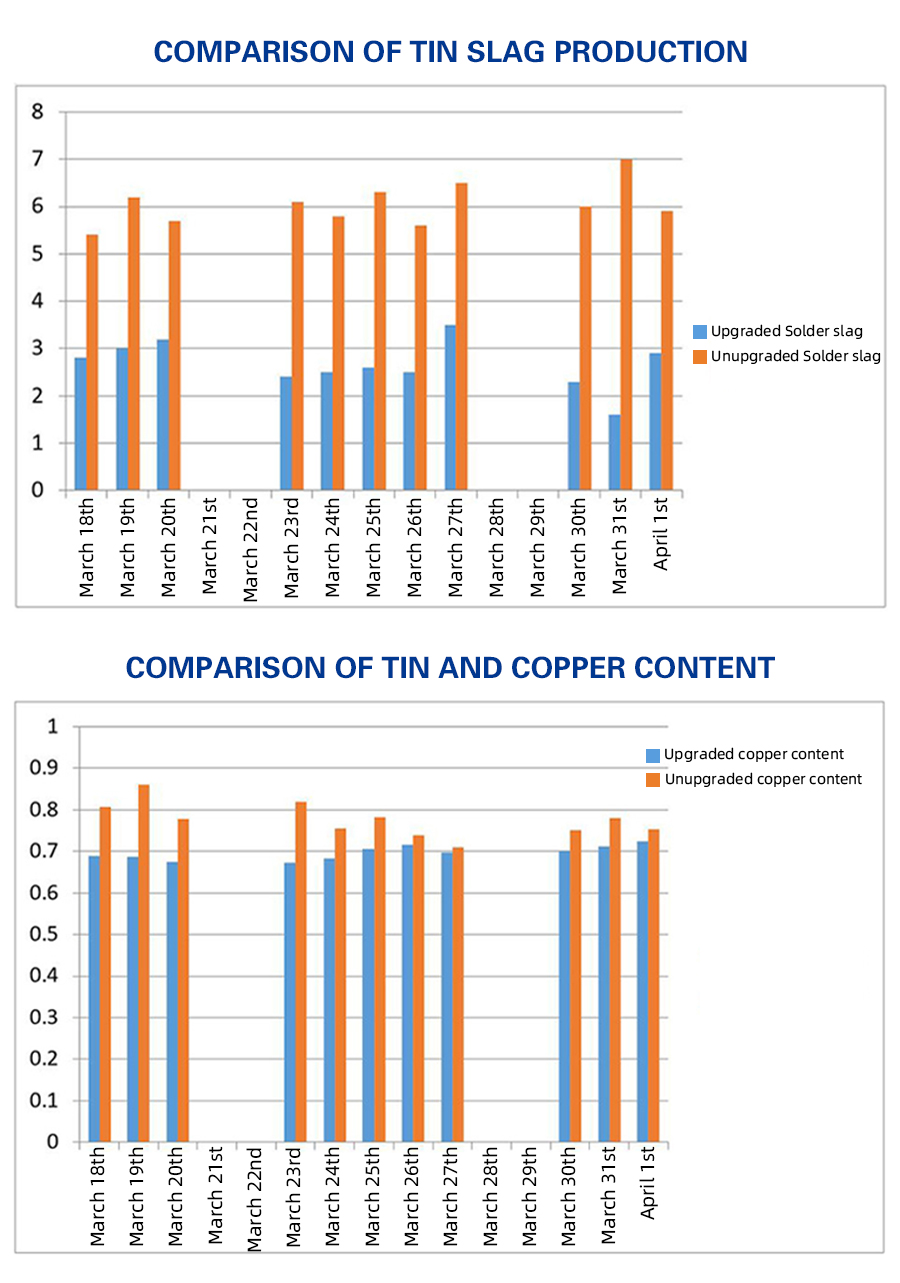
When the chain speed is increased from 70cm/min to 90cm/min under the same process conditions, the fluidity of the solder is significantly improved, and the residence time of the solder on the welding surface is shortened, which not only helps to wet the solder joint more evenly, but also reduces the risk of oxidation that may occur during the welding process. At the same time, due to the increase in solder fluidity, the temperature of the tin furnace can be maintained at a relatively low level, which reduces the generation of tin slag and makes the welding environment cleaner. In addition, due to the shorter welding time, the risk of precipitation of metal elements (such as copper and chromium) is reduced, helping to maintain the purity of the solder joint. In summary, increasing the chain speed not only improves the welding quality, but also improves the efficiency and reduces the material loss, bringing multiple advantages to the welding process.